A financial case study: Calabash Community Hospital
A homework in finance realized for my MBA


Photo: LEDC. (2024). Modern glass building with curved entrance. Unsplash. https://unsplash.com/photos/modern-glass-building-with-curved-entrance-under-sky-JtHwupBN3to
Preface
This article, based on a case study by Michael J. Schill, is my individual homework for the course of finance for my MBA, but a tad bit more epistemologically, methodologically, and strategically advanced since I already have an MSc.
Note: While studying for the final exam last week, I noticed that the increase in working capital needs should start at T0, rather than at T1. So that’s a minor mistake on my part, but it doesn’t change the final result since the NVP was already negative in the basic scenario.
PDF Version: https://drive.google.com/file/d/1ghlniPu1HHVvTlizYkYxAxGhB8hM3qCE/view?usp=sharing
Calabash Community Hospital
In this case study, the analyst will consider whether or not Calabash Community Hospital (CCH) ought to invest in the project to open up an ambulatory surgical center (ASC). In order to be scientifically rigorous, the analyst will proceed to perform a financial analysis based on the criteria of the Net Present Value (NPV) as well as that of the of Internal Rate of Return (IRR) (Ross et al., 2022, Chapters 7-8) in order to decide whether or not to proceed with the project (Damodaran, 2006, Chapter 5).
Note: All the dollar values in the following analysis are assumed to be in USD.
1. A SWOT Analysis: the good, the bad, and the ugly
A SWOT analysis is used to validate whether or not the strategic choices of an organization are in adequacy with its resources (most notably its strategic capabilities) and the contingencies in its external environment (Johnson et al., 2008, Section 3.6.4). In marketing, it is usually recommended to write a SWOT analysis for each segment (McDonald & Wilson, 2016, p. 63). For example, the needs of teenagers and young adults (e.g., sports and work injuries) are likely to be different than those of families (e.g., sick child) and those of elders (e.g., periodic examination, end-of-life treatments). Yet, for the sake of simplicity, the analysis will perform a single analysis encompassing all of the segments.
1.1. Internal Analysis: the inner journey on the path of self-actualization
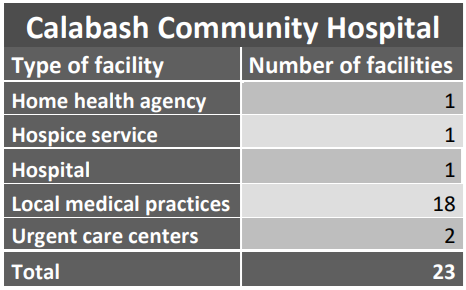
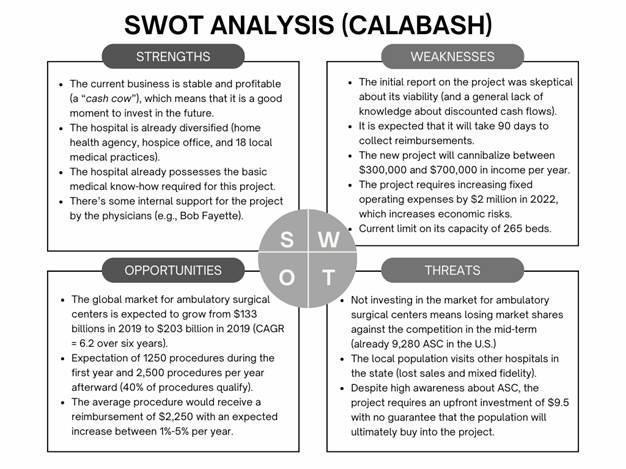
Calabash Community Hospital not only has a local monopoly as the sole hospital in town, but it also already possesses a solid local presence via its various external facilities: a home health agency, a hospice service, a couple of urgent care centers, and no less than eighteen local medical practices. Nevertheless, with 265 beds, its overall capability remains limited by its current infrastructure. Therefore, the current investment project offers an opportunity to grow.
On another note, despite possessing a local monopoly, the fact remains that customers are not attitudinally or even behaviorally loyal to the hospital: “There were no other hospital facilities in the county, but the population did frequent other hospitals in the state, including a major research hospital 90 miles away in Columbia.” (p. 2)
On the positive side, the hospital currently is financially profitable, which means that it is the ideal time to invest in promising projects for the future before the fountain of wealth dries out: “Business at the hospital had long been stable and profitable — a real cash cow.” (p. 1) Moreover, the project enjoys some internal level of support (e.g., Bob Fayette). Furthermore, Calabash is already diversified across related activities (Allaire & Firsirotu, 2004, Section 6.1), which means that it already has the expertise required to attempt a strategy of new product (service) development (Ansoff, 1957).
On the negative side, “the tone of the report was sceptical of the ASC proposal […]” (p. 1). Furthermore, the new project requires an upfront major investment of $9.5 millions in order to get on the rails, yet there’s ultimately no guarantee that clients (actual and potential) will get onboard with the project, at least enough to enjoy a positive return on investment (ROI) as measured by the criterion of the net present value (NPV) (Damodaran, 2006, Chapter 5). Moreover, engaging in this project is expected to “increase fixed operating expenses by $2 millions in 2022.” (p. 3) It goes without saying that increasing fixed operating expenses increases the financial risk for the hospital since those expenses cannot easily be adjusted in the short run (Naciri, 2020, Chapters 10–11). Finally, it is expected that the development of this new service will cannibalize the hospital’s operating income by $300,000 to $700,000 annually, which reduces the overall net profitability of the investment project.
1.2. External analysis: a hospital launched into a brave new world
1.2.1. The local market: our home turf
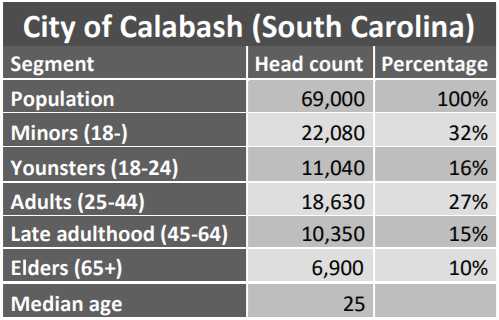
The city of Calabash is a small rural town of 69,000 inhabitants. On the bright side, the local population is fairly young, with a median age of 25 years old. Unless there’s a mass exodus, we can expect that those youngsters represent a higher customer lifetime value (CLV) (Kumar, 2018) [1] over the long run than, say, elders, who are more profitable in the short run but will most likely die before youngsters, ceteris paribus. That said, the case also strongly suggests that population growth is stagnating in this small community, which is a possible threat to the hospital's longevity in the long run: “The county population was fairly stable, with negligible recent historical or expected population growth. “ (p. 2)
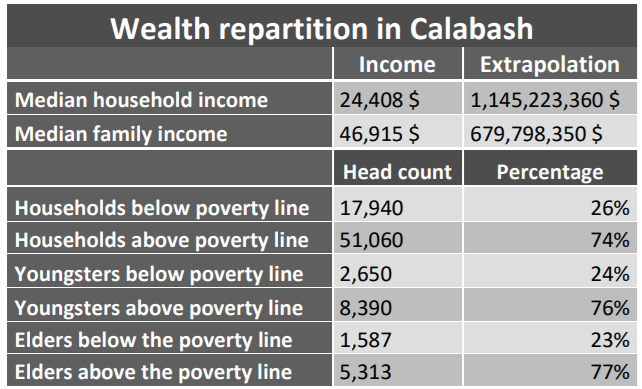
On the low side, the local population is fairly poor compared to the national average. Indeed, the median household income in Calabash is $24,408, and the median family income is $46,915, with 26% of the households living under the threshold of poverty. In comparison, the average household income in the United States in 2019 is $68,703, according to the Census Bureau. [2] In other words, the median household income in Calabash is 2.8 times inferior to the national median income. One possible risk of operating in a low-income community is the risk of above the average irrecoverable debts.
The extensive estimation of the market size is beyond the scope of this homework (and the information provided in the case study), but we can still make some naïve extrapolations for the sake of the argument. First, if we multiply the whole adult population by the median household income (46,920 * $24,408), we can estimate the local annual income of the whole population to be around $1.1 billion. Second, if we assume that the whole adult population (25-64 years old) is couples, we can estimate an annual familial income of about $680 millions (((18,630 + 10,350) / 2) * $46,915). Naturally, both estimations are offered as an illustration and do not constitute rigorous calculations by any stretch of the imagination.
1.2.2. The strategic group: who is the king of the hill?
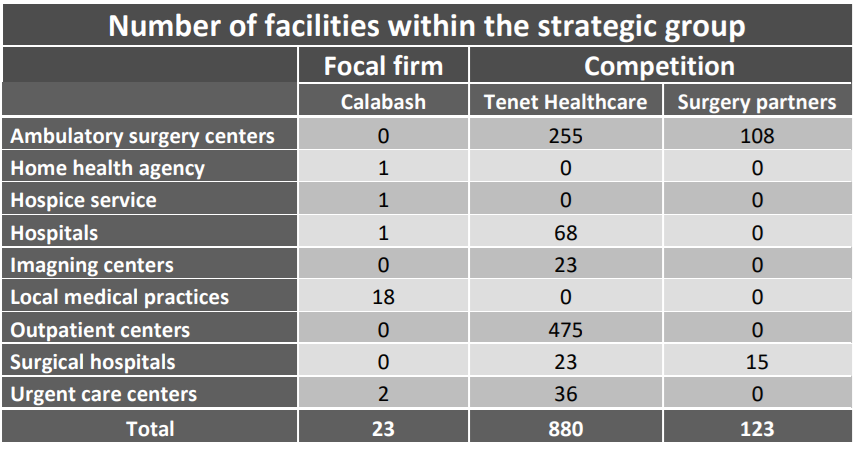
We do not have the financial data of Calabash, but we still can compare the number of facilities among “comparable” companies in its strategic group (Allaire & Firsirotu, 2004, Chapter 12). [3] The numbers speak for themselves: whereas Calabash locally is a big fish in a small pond, this community hospital really is a dwarf in the great scheme of things compared to national competitors. Beyond the sheer size difference, since Calabash is a not-for-profit community hospital, we can probably assume that its margins are fairly under those of for-profit competitors, putting it at a significant competitive disadvantage when it comes time to make major strategic investments.
1.2.3. The market for ambulatory surgical centers: is there a real opportunity here?
The market for ambulatory surgical centers is already substantial at the global scale and in growth (a forecasted CAGR of 6.2% over seven years period): “[…] the global size of the market for ASCs was expected to grow from $133 billion in 2019 to 203 billion in 2026.” (p. 2) In the United States, this represented 1707 million minor surgeries in the year 2018 alone.
That said, a growing market is not enough in itself. Before engaging itself, any organization must self-reflect and ask itself what is in it for them: “The team found that roughly 40% of hospital surgeries would qualify for outpatient procedures.” (p. 2) Concretely, for Calabash, it represents an opportunity of 1250 new procedures for the first year of operation, and 2500 afterward. For each of those procedures, it is expected that Calabash could expect “an average net reimbursement at $2,250 par procedure at today’s rate.” (p. 2) Hence, a prima facie, there’s a case for a potential business venture into this new activity.
1.3. Synthesis: a dialectical conclusion [4]
In the current context, there’s no doubt that there’s currently a market for the new service offer, and the proof is in the pudding: “there are more than 9,280 ambulatory surgery centers across the U.S.” (p. 3). But is this really a genuine argument to join the bandwagon of fellow merry corporations? If we are to take the whole concept of the Boston consulting Group (BCG) matrix seriously (McDonald & Wilson, 2016, pp. 193–199) ; we cannot rest on our laurels just because we are currently able to milk the cash cow of a profitable gig. Indeed, in business, whenever an organization leaves money on the table, it can be certain that savvy competitors will find a way to exploit the weakness and flank the organization with an innovative business model. Hence, a firm (or more precisely its “entrepreneurial managers”) must master the subtle arcanes of sensing, seizing, and transforming its strategic capacity in permanence (Teece, 2007) in this era where the velocity of the market is ever-increasing (Eisenhardt & Martin, 2000).
For sure, the financial risks are real for Calabash: an investment of $9.5 million is no small joke for a not-for-profit hospital. And an increase in its operational fixed expenses also inexorably increases its financial risk. Yet, the fact that local clients visit other hospitals in the state is a strong signal that there are unmet needs and potential to increase market shares (McDonald & Wilson, 2016, pp. 81–58), or lose them. Since we do not want to end up just like Don Quixote fighting windmills in a desperate attempt to preserve a dying order (e.g., chivalry), we must take seriously the opportunities and the threats brought forth by ASC.
The reader will find below a visual chart summarizing the principal strengths, weaknesses, opportunities, and threats (AKA SWOT analysis) discussed in the preceding strategic analysis. And since the administrative science is a praxeology epistemically grounded in empiricism rather than some wishy-washy pious wishes on how the world ought to be (Allaire, 1984), the next section will be where the rubber meets the road. Using the criteria of the net actualized value (NPV) (Ross et al., 2022, Chapters 7-8), the analyst will evaluate whether there’s a bona fide financial case for going forth with this audacious project, or rather if it really is but a foolish endeavor rooted deeply in epistemic and normative idealism.
Canva: https://canva.link/258346u5b6606de
1.4. Limits: since any analysis is perfectible
Similar to a PEST analysis (Burt et al., 2006) and other variants of macro-environmental analysis, SWOT analyses have the major flaw of being relatively static. Most notably, its categorical approach falls shorts on displaying the various interrelations and interdependences between the elements, more or less arbitrarily put into the different buckets. Although beyond the scope of this analysis, the SWOT analysis can be completed with a TWOS matrix in order to put in relation the strengths and the weaknesses of the focal firm with the opportunities and threats ever-present in its external/competitive environment (Johnson et al., 2008, pp. 259–261).
2. The financial analysis: where the rubber meets the road
2.1. The research methodology: the match plan
In order to be rigorous in our analysis and make sure that we do not forget any important details, we need a solid research methodology. First, the analysis used AI to quickly extract the key elements from the case study, in occurrence the expenses, revenues, and their expected growth. Naturally, since LLMs are prone to hallucination, it is important to peer-review the results proposed using the case study, hence the absolute necessity of “critical thinking in the age of generative AI” (Larson et al., 2024).
Then, using the AI output, the analyst compiled the data into separate tables in Excel. Subsequently, the analyst copied and pasted those tables into the present document and analysed them separately. One could argue that pre-analysing the data is tenuous, but it is important to understand the implication of each element before performing the actual calculation of the net present value (NPV), otherwise faulty logic and reasoning might creep in a manner which is difficult to detect post-hoc (unless one is overly reliance on generative AI to write his or her report, which is a risk in itself). Next, the analyst combined both the expected revenues and expenses in a separate Excel sheet to perform the actual discounting analysis. Finally, the analyst reviewed the results and formulated his recommendation to the client.
2.2. The revenues: where are the cash inflows expected to come from?
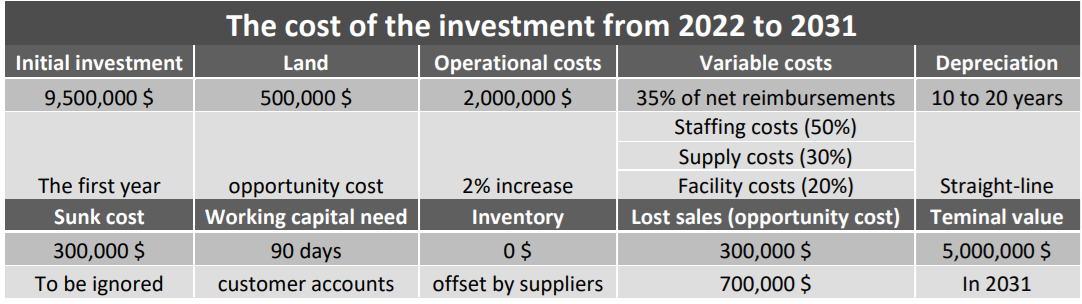
Once the ambulatory surgical center is fully operational, the hospital is expected to be able to perform 2500 procedures per year, with no expected yearly growth in volume from 2023 to 2031. Yet, for the first year of operations (2022), the new facility will only be able to perform at half its maximum capacity (1250 procedures). From a strategic perspective, this capacity constraint during the first year increases the payback period (Ross et al., 2022, Section 7.2-7.3), which is a potential source of risks. Still, it should not be overly problematic, since “[b]usiness at the hospital has long been stable and profitable.” (p. 1)
The base scenario expects the net average reimbursement to be $2250 per procedure. Concretely, this represents an expected nominal income of $2.8 million for the first year and $5.6 million for the subsequent years. An alternative scenario evaluated the possibility of using a mixed procedure, which could increase the reimbursement of each procedure by $250. But there’s a catch since nothing in this world is free: in this alternative scenario, the yearly opportunity cost would increase by $300,000 (2500 * $250 - $300,000 = $325,000 could still be technically viable).
Previous analysis suggests that “over the next five years, the rate of increase for reimbursements, including general inflation, could conceivably be between -1% and 5% per year” (p.2), and decided that 1% growth was the most likely scenario. Therefore, the analyst will use one 1% as the base scenario, but once the Excel is automated, it becomes relatively easy to evaluate multiple growth scenarios (Ross et al., 2022, Section 9.2) to increase the thoroughness of our analysis. [5]

2.3. The expenses: what will be our liabilities?
A prior investment of $300,000 in design and engineering was already invested in this project. This is what is commonly known as a sunk cost, that is, a “cost that has already occurred”, and therefore that “cannot be changed by the decision to accept or reject the project.” (Ross et al., 2022, p. 210) In other words, sunk costs must be excluded from the calculation of the net present value of the project (NPV) because no matter the subsequent decision, those $300,000 cannot be retrieved –they are lost forever.
At date 0, that is, even before the project can begin, Calabash Community Hospital (CCH) will need to invest the hefty sum of $9.5 million to kickstart the project. Once the project begins on date 1, the operational costs of the hospital will increase by $2 million per year, with an “expected increase of 2% in annual rate after 2022.” (p. 3) Variable costs, that is, staffing, supply, and facility costs, are expected to represent a portion of net insurance reimbursement ($2250 * 35% = $787.50 per procedure).
The ultimate duration of amortization is unclear – it could be anytime between 10 and 20 years using straight-line depreciation. Yet, since depreciation ultimately leads to no cash flow movement (nor can we calculate this information to calculate the tax shield since we don’t have the required information (Ross et al., 2022, Chapter 8)), we need to exclude depreciation from our evaluation of the Net Present Value (NPV). In any case, the expected terminal nominal value of the project is $5 million. Additional financial considerations include a working capital need of 90 days and the hypothesis no inventory costs. [6]
Finally, we will need to account for two opportunity costs “because, by taking the project, the firm forgoes other opportunities for using the asset.” (Ross et al., 2022, p. 210) The first one is the land upon which we will build the facility. A naïve assumption might be to presuppose that the cost of this asset is free since we already own it, but it’s not. Indeed, by building our facility on this site, we forgo the opportunity of selling the land immediately for the whole duration of the project, hence the opportunity cost. The second is the annual lost sales, ranging from $300,000 to $700,000. Those costs are “not expected to increase over time” (p. 3), but since the actual amount is uncertain, our Excel sheet will need to be flexible enough to allow the analyst to play around with the dollar value of this opportunity cost.
2.4. What is the net present value of the project?
2.4.1. How do we mathematically represent the NVP for this project?
Now that we have sorted the various constraints of the project, we can estimate[7] the net present value (NPV) of the ambulant surgical center (ASC) project. Ultimately, the formula for calculating the NVP of a project remains straightforward; the real challenge is to identify the elements to include in the investment project and, most importantly, to determine the appropriate hurdle rate (Damodaran, 2006, pp. 201–210).
For the current project, the huddle (or discount) rate considered to be appropriate is 7%. All in all, the generic formula for the NVP is as follows (idem, p. 209):

IF we consider all the variables for this specific project, the formula would be more or less as follows:
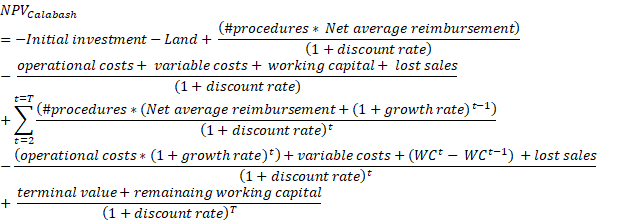
Note: In the above formula, the analyst kept the variables generic to reflect the fact that the Excel file ought to be programmed to accommodate variable values in order to test multiple assumptions (e.g., different discount rates, growth rates, etc.).
2.4.2. How to use the Excel file?
The author of the current report possesses a college degree in computer science and a background as a software developer (ERP systems for the repair shop industry). He therefore programmed the Excel file to be highly configurable so the whole table used to calculate the net present value (NVP) would automatically update if any parameter (hypothesis) were changed. The idea here is to allow the user to quickly perform sensitivity and scenario analyses (Ross et al., 2022, Section 9.2) in real time.
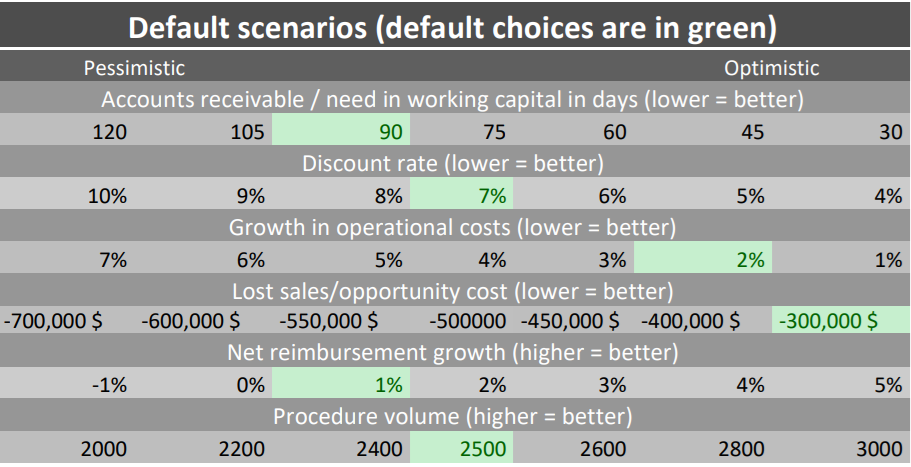
The following table presents a preselection of values or, if you prefer, a curation of plausible hypotheses that the user of the Excel file can use as input in order to dynamically test various scenarios. A value on the “pessimistic” (left) side means that selecting it will reduce the probability of having a positive value in the NVP calculation because it either increases costs or reduces income. Conversely, selecting values on the “optimistic” (right) side of the table either increases sales or reduces the cost of the project, thus increasing the output amount of the net present value (NPV) function.
Therefore, all else being equal, lowering the need in working capital (the time needed to recover accounts receivable), lowering the growth rate in operation costs, lowering the lost sales caused by service cannibalization, increasing the growth rate of average net reimbursements, and increasing the number of procedures performed every year all will contribute individually or collective to increase the value of the net present value (NPV) function. The value selected in green was that recommended in the case study, except for the opportunity cost due to lost sales, which was a range of values (between $300k and $700k). The author of the report thus selected $300k as the default value, since if the lowest opportunity cost cannot generate a positive net present value (NPV), no other higher values will.
Concretely, using the “hypotheses” table, the user can either reference any cell in the “scenario” table or manually write any value, which will automatically update the values in the “cashflow” table and thus the results in the “decision rules” table.
All else being equal, decreasing the value of the initial investment, reducing the opportunity cost for the land used to build the facility, increasing the terminal value of the project, decreasing the discount rate, decreasing the opportunity cost (cannibalization of existing services), increasing the number of procedures perform every year, increasing the average net reimbursement, increasing the yearly growth rate of those reimbursements, reducing the number of days require to recover the accounts receivable, reducing the yearly operational costs, reducing the yearly growth of those operational costs, and reducing the variable costs will increase the probability of generating a positive net present value (NPV).
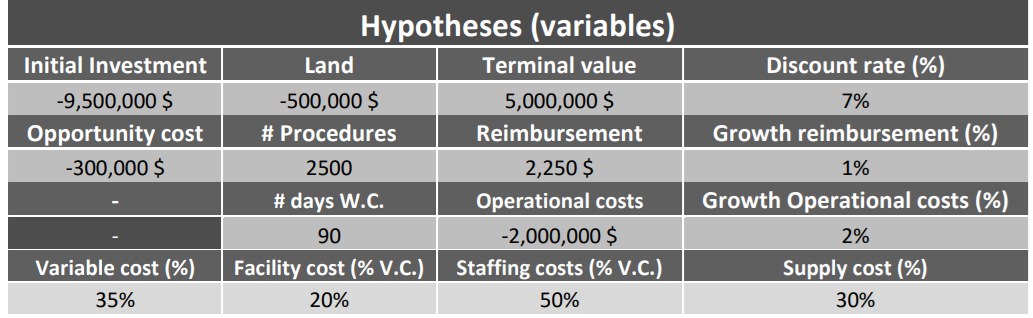
The author of this report will now use the inputs (AKA hypotheses) presented in the table above to evaluate the net present value (NPV) of the default scenario as specified in the case study.
2.4.3. The evaluation of the base scenario

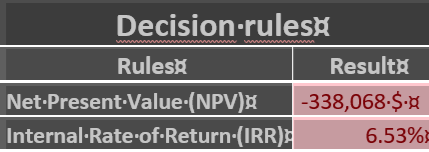
As the user can read in the lower right corner of the table, although the project generates positive cash flows ($6.5 millions) over the lifetime of the project, those cash flows become negative when they are actualized at a discount rate of 7%. Unsurprisingly, the net present value (NVP) for this project is negative (notice that this is the exact same value as summing the discounted cash flows in the table above). The typical rule of thumb is that a project generating a negative value ought to be rejected. The analyst also calculated the internal rate of return (IRR):
“The basic rationale behind the IRR is that it tries to find the single number that summarizes the merit of the project. That number does not depend on the interest rate that prevails in the capital market. That is why it is called the internal rate of return; the number is internal or intrinsic to the project and does not depend on anything except the cashflows.” (Ross et al., 2022, pp. 186–187)
As we can see in the decision rule table, the internal rate of return (IRR) is inferior to the discount rate (6.53% < 7%), which is consistent with a negative net present value (NPV). Therefore, both decision rules conclude that Calabash Community Hospital (CCH) should reject the project.
3. Conclusion: My strategic recommendations
Considering that R. D. Scott was the only member during the meeting who knew the meaning of “discounted cash flow” (DCF) in the context where the net present value (NPV) for the ambulatory surgical center (ASC) is negative, it is rather unsurprising that: “the tone of the report was skeptical of the ASC proposal, and when the tam had concluded by recommending against the investment, a subset of the audience came unglued.” (p. 1) The case study clearly demonstrates that even though a project can generate positive cash flows, it can still prove to be unprofitable when accounting for the value of time. In particular, this project requires a massive investment upfront ($10 millions at year 0), but the highest capital inflow, the terminal value ($5 million), only comes at the very end of the project (year 10).
That being said, does that mean that we should: “throw the baby out with the bathwater”? The typical financial common sense would argue that we should reject the project, and this is exactly the conclusion that your typical MBA student trained to think in terms of rules of thumb (heuristics) (Simon, 1959; Schwartz, 2002) and models would naturally come to. But genuine critical thinking in leadership (McVey, 1995) and the teaching of strategy in business schools (Jenkins & Cutchens, 2011; Albert, 2021) clearly call for more than “satisficing”. [8] Indeed, savvy students who were diligent about their reading will know at this point about the crucial strategic notion of “real option” in finance:
“NVP analysis […] ignores the adjustments that a firm can make after a project is accepted and uncertainty surrounding cash flow estimates is resolved. These adjustments are called real options. In this respect, NVP underestimates the true value of a project, particularly in industries such as mining, oil and gas, pharmaceutical, and biotechnology, where investments are large and uncertainty about future outcomes makes the flexibility about real options valuable.” (Ross et al., 2022, pp. 259–260)
For example, opening a single speciality restaurant might not be profitable in and of itself, but opening a franchise after testing a pilot project might prove to be profitable enough to convince investors to get on board with the project, which they would have rejected otherwise (Ross et al., 2022, Section 24.2). Similarly, opening a single ambulatory surgical center (ASC) might not be profitable (based on the NVP criterion) as a standalone project, but might become much more attractive if the positive (undiscounted) cashflows are immediately reinvested to open additional ASCs, as the potential for this market is real (currently 9,280 ACCs in the U.S. alone, and expected global growth of $70 billion over 7 years).
As discussed in the SWOT analysis, the fact that Calabash Community Hospital as long been profitable is of no guarantee that the situation will remain the same over the long run: “The inconvenient yet inevitable conclusion is this: No single marketing strategy works for every firm, in every place, or for all time.” (Palmatier & Crecelius, 2019, p. 7) Even though the internal rate of return (IRR) of the project is inferior to the discount rate, there’s also risk to “active inertia” (Sull, 1999). Indeed, refusing to join the market right now might mean losing market shares and even missing the train on an important shift in consumer behavior. Therefore, the author of the present report recommends that the board carefully consider all the “real options” on the table, as well as future market trends, before rejecting the ASC project.
End notes
[1] It’s worth noting, though, that marketers usually calculate the customer lifetime value (CLV) of their portfolio of customers over a period of three years, even though the real relationship might last for much longer (e.g., in Canadian banking). In that regard, elders will most likely bring in more income in the short-run than young adults. So, whether or not we consider the young age of the population as an opportunity is a matter of perspective and debate based on the timescale we are using for our analysis. There are many ways in the literature to calculate this ratio, but here’s one simple one (Kumar, 2018, p. 8):

[2] U.S. Census Bureau. (2020). Income and Poverty in the United States: 2019. https://www.census.gov/library/publications/2020/demo/p60-270.html
[3] Right at the onset, we can formulate two criticisms. First, there’s no case to be made that such large national competitors are comparable to the focal firm (and a non-for-profit community hospital of all things). Second, since the reader does not possess the financial data for Calabash, we cannot make many meaningful comparisons with its so-called “comparable” competitors.
[4] See Karl Popper (1940) to learn more about this most ancient mode of argumentation and his criticisms of the dialectical method.
[5] The most advanced form of scenario analysis would arguably be a Monte Carlo simulation (Ross et al., 2022, Section 9.3), but that is beyond the competencies of the analyst for this report.
[6] This is a constraint in the case study, but one might genuinely ask oneself how Calabash Community Hospital can have a recuperation period of 90 days on its accounts receivable, but no worries in the world about accounts payable in its whole operating cycle (Ross et al., 2022, Section 27.3).
[7] Estimate, indeed, since we can never be one hundred percent certain of the future, hence the whole notions of expected value and risk inherent to finance. In the present case, we also have to consider that some values are presented as a range of possible values (e.g., lost sales, depreciation). Therefore, we will need expert judgment and a flexible Excel sheet in order to determine the most appropriate scenario.
[8] Or maybe ought we to limit ourselves to the “satisficing principle” when times come for capability learning (Winter, 2000), but let’s not caricature too much here since evolutionary economics as theorized by Richard Nelson and Sidney Winter, really is all about epistemic voluntarism in an ever-changing world of constant Schumpeterian “creative destruction” (Nelson & Winter, 2002; Nelson, 2021).
Bibliography
Academic and professional papers
Albert, S. (2021). Applied critical thinking in strategy: Tools and a simulation using a live case. Journal of Education for Business, 96(4), 252–259. https://doi.org/10.1080/08832323.2020.1792395
Allaire, Y. (1984). Le savant et le Manager: Essai sur l’épistémologie de la recherche en gestion .
Ansoff, I. (1957). Strategies for diversification. Harvard Business Review, 35(5), 113–124.
Burt, G., Wright, G., Bradfield, R., Cairns, G., & Van Der Heijden, K. (2006). The role of scenario planning in exploring the environment in view of the limitations of pest and its derivatives. International Studies of Management & Organization, 36(3), 50–76. https://doi.org/10.2753/IMO0020-8825360303
Eisenhardt, K. M., & Martin, J. A. (2000). Dynamic capabilities: What are they? Strategic Management Journal, 21(10–11), 1105–1121. https://doi.org/10.1002/1097-0266(200010/11)21:10/11%3C1105::AID-SMJ133%3E3.0.CO;2-E
Jenkins, D. M., & Cutchens, A. B. (2011). Leading critically: A grounded theory of applied critical thinking in leadership studies. Journal of Leadership Education, 10(2), 1–21. https://doi.org/10.12806/V10/I2/TF1
Kumar, V. (2018). A theory of customer valuation: Concepts, metrics, strategy, and implementation. Journal of Marketing, 82(1), 1–19. https://doi.org/10.1509/jm.17.0208
Larson, B. Z., Moser, C., Caza, A., Muehlfeld, K., & Colombo, L. A. (2024). Critical thinking in the age of generative ai. Academy of Management Learning & Education, 23(3), 373–378. https://doi.org/10.5465/amle.2024.0338
Nelson, R. R. (2021). A perspective on the evolution of evolutionary economics. Industrial and Corporate Change, 29(5), 1101–1118. https://doi.org/10.1093/icc/dtaa045
Nelson, R. R., & Winter, S. G. (2002). Evolutionary theorizing in economics. Journal of Economic Perspectives, 16(2), 23–46. https://doi.org/10.1257/0895330027247
Palmatier, R. W., & Crecelius, A. T. (2019). The “first principles” of marketing strategy. AMS Review, 9(1–2), 5–26. https://doi.org/10.1007/s13162-019-00134-y
Popper, K. R. (1940). What is Dialectic? Mind, 49(196), 403–426. http://www.jstor.org/stable/2250841
Schwartz, H. (2002). Herbert Simon and behavioral economics. The Journal of Socio-Economics, 31(3), 181–189. https://doi.org/10.1016/S1053-5357(02)00161-0
Simon, H. A. (1959). Theories of decision-making in economics and behavioral science. The American Economic Review, 49(3), 253–283. https://www.jstor.org/stable/1809901
Sull, D. (1999, July 1). Why good companies go bad. Harvard Business Review. https://hbr.org/1999/07/why-good-companies-go-bad
Teece, D. J. (2007). Explicating dynamic capabilities: The nature and microfoundations of (Sustainable) enterprise performance. Strategic Management Journal, 28(13), 1319–1350. https://doi.org/10.1002/smj.640
Winter, S. G. (2000). The satisficing principle in capability learning. Strategic Management Journal, 21(10–11), 981–996. https://doi.org/10.1002/1097-0266(200010/11)21:10/11%3C981::AID-SMJ125%3E3.0.CO;2-4
Artificial intelligence
ChatGPT was used to quickly extract the key ideas from the case study and outline the basic drafting plan. The Grammarly extension on Google Chrome was used to quickly correct the orthograph paragraph and paragraph (using an online textbox). The author did not accept the rewriting proposal in order to keep a sense of authenticity in his work.
Conversation: https://chatgpt.com/share/69d4056d-9168-832f-98b8-1416c41d931f
Books
Damodaran, A. (2006). Applied corporate finance: a user’s manual (2. ed). John Wiley.
Johnson, G., Scholes, K., Wittington, R., & Fréry, F. (2008). Stratégique (8e éd). Pearson education.
McDonald, M., & Wilson, H. (2016). Marketing plans: How to prepare them, how to profit from them (Eighth Edition). Wiley.
Naciri, A. (2020). Nouvelle méthode d’interprétation des états financiers: Une approche socio-économique. Presses de l’Université du Québec.
Ross, S. A., Westerfield, R., Jaffe, J. F., & Driss, H. (2022). Corporate finance (Ninth Canadian edition.). McGraw Hill.
Case study
Schill, M. (2022). Calabash Community Hospital. University of Viginia. https://store.hbr.org/product/calabash-community-hospital/UV8031?sku=UV8031-PDF-ENG